



























The incredible history of vermicomposting

From the “intestines of the Earth” to our homes!
The history of vermicomposting began a very long time ago, well before the invention of bins and waste collection lorries. Nature has always recycled its waste thanks to discreet but essential players: earthworms. Their role is so fundamental that philosophers and scientists understood it long before us.
 AntiquityAristotle and the “intestines of the Earth”
 19th centuryDarwin becomes fascinated by earthworms
 1980sThe rise of vermiculture
 Late 20th centuryDecline: incinerators and chemical fertilisers
 TodayA strong comeback all over the world
In Antiquity, the Greek philosopher Aristotle closely observed nature. He gave earthworms a nickname as surprising as it was apt: he called them the “intestines of the Earth”. With this image, he explained that the soil, like a living organism, needed worms to digest organic matter and stay fertile.
 Centuries later, in the 19th century, the famous scientist Charles Darwin — known for his theory of the evolution of species — became fascinated by these little creatures. He even devoted the last book of his life to earthworms, entitled The Formation of Vegetable Mould through the Action of Worms. In his view, no other creature has played such an important role in the history of life on Earth.
For a long time, composting was a natural, everyday practice. Before waste collection existed, kitchen scraps were simply placed at the bottom of the garden. At that time, people did not yet distinguish between the different types of worms: those that plough the soil deep down and those that feed on organic waste at the surface.
It was not until the 1980s that worm farming, known as vermiculture, became truly popular. The practice was then presented as eco-friendly, profitable and easy to set up. Many people enthusiastically embarked on this adventure.
But after this craze, vermicomposting gradually fell into oblivion. Towns and cities favoured building incinerators to burn waste. Intensive agriculture expanded, making heavy use of chemical fertilisers and weedkillers, which wiped out earthworms from many soils. Meanwhile, the public was not yet aware of waste sorting: it was the era of “everything in the bin”.
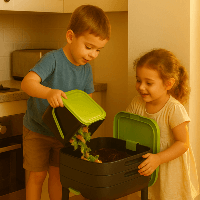 In recent years, the situation has changed profoundly. In the face of global warming and environmental challenges, attitudes are shifting. Vermicomposting is making a strong comeback, as it offers a simple, local and effective solution. Every kilo of waste eaten by the worms is one kilo less to transport, burn and pollute.
Recycling at home: vermicomposting today
This technique is now used all over the world to replace chemical fertilisers. In Cuba, vermicomposting centres had produced more than a million tonnes of natural fertiliser by 2003. In India, nearly 200,000 farmers have adopted this method. Today, this incredible story continues thanks to you: millions of households are turning their organic waste into a valuable resource at home, using a composter… and above all a wormery.

