










Best Seller
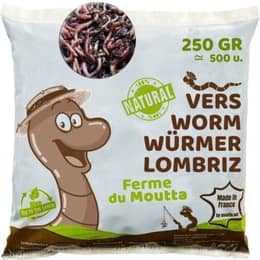
Compost worms Eisenia | 250 g of worms (approx. 500 pcs)
Packaging from 250 g to 10 kg of worms
13,57 €
-25%
Fast and odourless, compost worms eat your waste and turn it into worm casting for your plants.

From 2 to 4 trays with optional planter.

Up to 18 growing zones with central wormery.

Terracotta with flower pot.

From 2 to 4 shelves with a low shelf.

Urbalive, Worm Cafe, WORMcube, Tiny Worm, WORMwood, ...

Turn your planters into a Wormery: WORMacotta, In-Ground.
From the kitchen to the garden, your compost becomes simple, quick, and effective for everyone.
Live animals (worms and bait) and products to feed and care for pets and livestock.

Compost worms Eisenia for your wormery or worm compost bin.

Ultra-fresh worms: Bedding, Dendros and Canadians from 100 g to 1 kg.

Natural solutions dedicated to the well-being of horses, ponies, and donkeys.

Optimise the health and performance of your farm.

Mealworms, natural and nutritious supplements.
Enhance your home with our decorative items and care for your house in a natural and sustainable way.
Grow your garden in an eco-friendly and nature-friendly way, for healthy and sustainable plants.
EM-based products designed to enrich soils, protect plants, support animal health, and make everyday well-being and maintenance easier.

Contains a blend of 80 families of beneficial microorganisms.

Revitalise, purify and improve water quality in all your applications.

Stimulate soil microbial activity and plant growth.

Cleanse and maintain your environment naturally.

For the well-being and health of pets, livestock, and horses.

Enrich your body or dietary routines with essential enzymes.

Buying your first compost worms from a specialist supplier remains the most reliable way to get started, as we explain in our guide Which type of worms should you use in your wormery? But it isn't the only option: in good conditions, a worm population doubles every two to three months, so many home wormery owners end up with far more worms than they need. Here's where and how to get hold of that surplus for free.
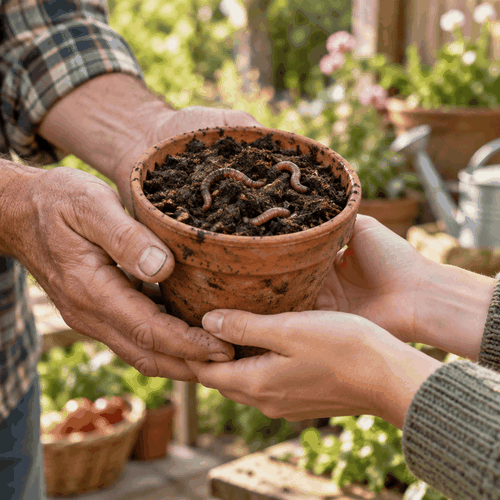 This is the simplest and often the quickest route: family, friends, neighbours, colleagues. Vermicomposting is becoming increasingly popular, and there's a good chance someone in your wider circle already has a well-established wormery. A mature colony copes very well with having some of its worms taken: giving away a shovelful of worm-rich compost puts the original wormery in no danger whatsoever, as the population quickly recovers.
This is in fact a characteristic specific to compost worms: their population naturally regulates itself according to the space and food available. The higher the density in a bin, the more the breeding rate automatically slows down, until it stabilises. Taking some of the worms therefore simply frees up space and food for the remaining worms, which then return to their usual breeding rate — a gift of worms benefits the recipient just as much as the original colony.
Don't hesitate to post a request on neighbourhood groups or local social networks either (local Facebook groups, neighbourhood giveaway apps, local gardening forums): wormery owners looking to give away surplus worms are far more common there than you might think.
Willy's tipA healthy wormery naturally produces more worms than it needs: asking someone who already practises vermicomposting for a few costs them nothing, and saves you the price of your first worms.
Community composting associations, community gardens and some environmental education organisations often run composting sites that naturally host populations of compost worms. Many are happy to give away a small quantity to help a new household get started, especially if you get a little involved in the life of the site (occasional volunteering, membership). A quick search for the composting association or community garden nearest to you is often the most effective starting point.
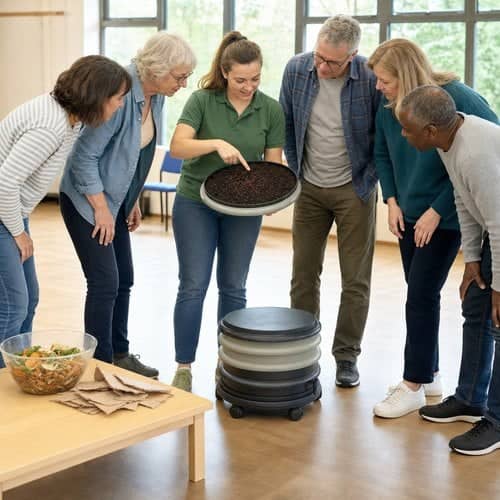 As part of their waste reduction programmes, many local authorities hand out wormeries already stocked with worms at public meetings, zero-waste events or through school programmes. If your local council runs this kind of scheme, it's often a chance to go home with a complete wormery, worms included, without spending a penny. Check with your council's environment or waste department to find out whether such a scheme is planned near you.
A gift of worms is still a useful present, provided you check a few points before settling them in:
 Quantity: to get off to a good start, ideally allow the equivalent of at least 250 to 500 grams of worms. A batch that is too small will take longer to settle in and to process your first scraps.
 General condition: active worms that recoil quickly from light and have nicely moist skin are a good sign. We go into the signs of a healthy worm in detail in our guide Which type of worms should you use in your wormery?
 Origin of the batch: always choose worms from an existing wormery (established compost) rather than worms picked up at random in a garden, which may not be a suitable species.
 A short adjustment period: a batch of unknown origin may take a few days to acclimatise to its new environment. Don't worry if activity seems a little low at first.
Willy's tipThe best gift of worms always comes from a wormery that is already up and running: you get not only suitable worms but also a small community of micro-organisms already well versed in the process.
If none of these avenues works out, head to our range of Eisenia compost worms to start with a batch whose species and quantity are guaranteed. Once you have your worms, see our guide How to start your wormery for the next steps.


