












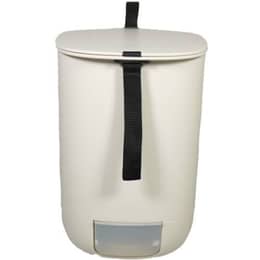
Urbalive Bokashi Composter
Capacity 10.6 litres, available singly or in a set of 2
£54.91 €65.83
Fast and odourless, compost worms eat your waste and turn it into worm casting for your plants.

From 2 to 4 trays, with an optional planter.

Up to 18 growing areas around a central wormery.

Terracotta with flower pot.

2 to 4 trays with a lower shelf.

Trays you add over time, for easy harvesting of vermicompost.

Turn your planters and flower beds into a wormery: WORMacotta, In-Ground.
 Practical guide

From the kitchen to the garden, your compost becomes simple, quick, and effective for everyone.
 Practical guide
 Practical guide
Live animals (worms and bait) and products to feed and care for pets and livestock.

Eisenia compost worms for your wormery or composter.

Ultra-fresh worms: compost worms, Dendros and Canadians from 100 g to 1 kg.

Natural solutions dedicated to the wellbeing of horses, ponies and donkeys.

Optimise the health and performance of your farm.

Mealworms, natural and nutritious supplements.
Enhance your home with our decorative items and care for your house in a natural and sustainable way.
Garden in an eco-friendly way that respects nature, for healthy and sustainable plants.
EM-based products designed to enrich soils, protect plants, support animal health, and make everyday well-being and maintenance easier.

Contains a blend of 80 families of beneficial microorganisms.

Revitalise, purify and improve water quality in all your applications.

Stimulate soil microbial activity and plant growth.

Cleanse and maintain your environment naturally.

For the wellbeing and health of pets, livestock and horses.

Enrich your body care or dietary routines with essential enzymes.
 Practical guidePractical guide

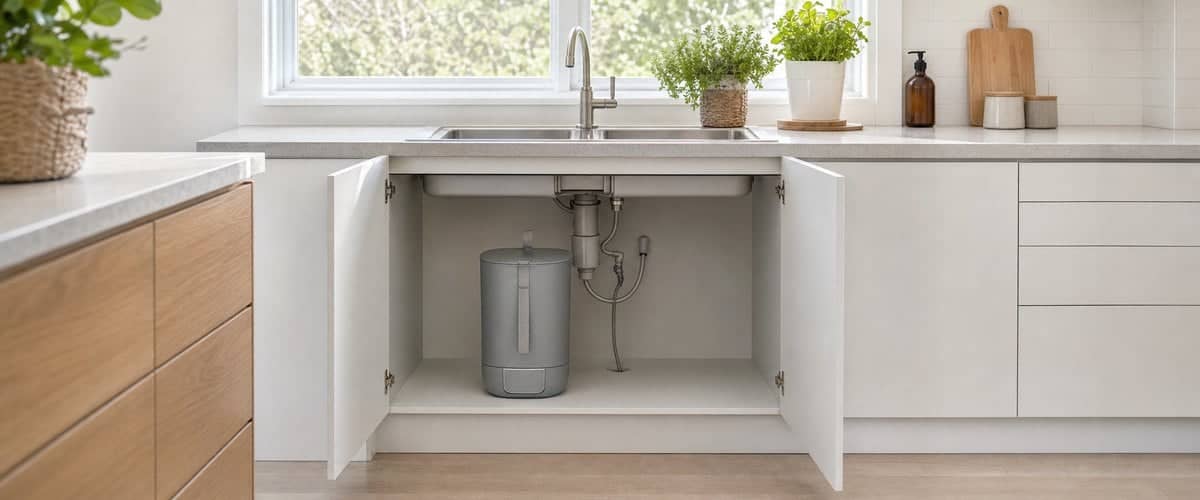
Bokashi has one big advantage: it can be kept indoors, just a step away from the chopping board. You still need to find it the right spot, though. The micro-organisms that ferment your scraps like a gentle, steady warmth; you, on the other hand, need a bin that is easy to reach, that you will open once a day and drain regularly.
Here are the ideal conditions, the best spots in your home, and the precautions to take if you have no choice but to keep it outdoors.
 Lactic fermentation works best at room temperature. Not all sources give the same range, but they converge on the same benchmark: roughly between 18 and 25 °C, the temperature of a heated room. Bokashi can cope with slightly warmer conditions, up to around thirty degrees.
In cooler conditions it still works, but more slowly. Below about ten degrees, fermentation slows down markedly, and at around 5 °C it almost stops. It starts up again when the bin warms up: the cold puts the process on hold, it doesn't destroy it.
Three rules for choosing the spot:
 No direct sunlight. A plastic bin in the sun heats up well beyond room temperature. Avoid windowsills and patio doors.
 A stable temperature. A consistently warm corner is better than a place that swings from hot to cold, such as a conservatory.
 Easy access. A bin that has to be moved every time ends up being neglected.
Key pointsThe right spot is warm, shaded and at a stable temperature: around 18 to 25 °C, out of the sun. In cooler conditions, bokashi simply works more slowly, with no harm done.
This is the most common spot, and for good reason: it's in the kitchen, away from the light, at the right temperature. Just check the available height. You need to be able to open the lid without taking the bin out, or take it out easily, and slip a glass under the tap.
These are excellent choices if they are heated or kept mild. A warm laundry room is actually ideal. A closed cupboard also works, as long as you don't forget the bin inside: regular draining is still essential.
Some bins are made to be seen. The Skaza Organko 2 Bokashi Composter, compact and award-winning for its design, or the Urbalive Bokashi Composter with its liquid drawer, easily find a place on a worktop or shelf, away from the window.
Emy's tipStore your supply of activator in a tightly closed box, in a cool, dry cupboard, never on the windowsill or above the cooker.
Bokashi is designed for indoor use, but some people don't have the space or prefer to keep it outside. That's possible, with a few precautions.
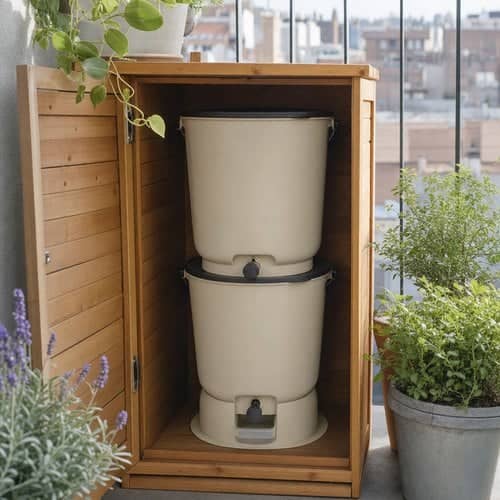
Place the bin in the shade all day long and sheltered from the rain, against a wall or inside a chest. In summer, keep an eye on the heat: a south-facing balcony can turn into an oven.
 In winter, bring the bin indoors or protect it. Freeze-thaw cycles can crack the lid or the tap, and a bin that freezes while being filled stops fermenting.
These are often too cold in winter for a bin that is still being filled: fermentation will be slow there. On the other hand, they are a very good place to store a bin that has already fermented until you can bury it. For dealing with cold and heat, see our guide bokashi in winter, in summer and during the holidays.
A bin left outdoors is exposed to every temperature swing, and it may attract curious animals. If this is your only option, choose a shaded, sheltered corner and keep the lid tightly closed.
With the lid closed, a healthy bokashi bin is very discreet: that's what makes it possible to keep it in the kitchen. When you open it, however, it does have a smell, and that's normal. It is sour, similar to gherkins, cider vinegar or sauerkraut. Some people even find it pleasant; it fades within moments.
What isn't normal is a putrid smell, a smell of rotten eggs or ammonia. It signals a problem (not enough activator, too much liquid, a lid not properly closed), and the location is almost never to blame. To find the cause, see our guide bad smells, too much liquid, fruit flies: troubleshooting your bokashi.
Did you know?Fruit flies don't come from a properly closed bokashi bin: they are attracted to scraps left in the open air. The small kitchen caddy used for collecting scraps and drips of liquid around the tap are often the real culprits.
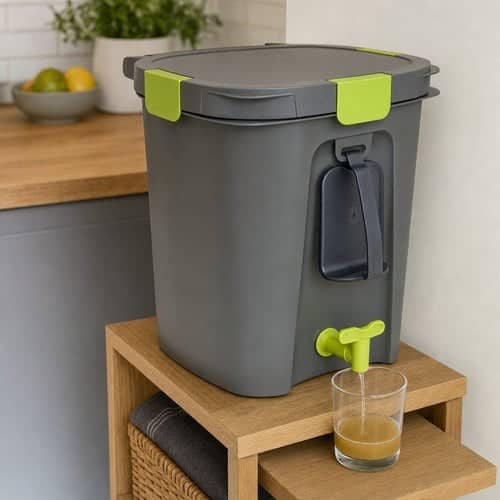 You will be draining the liquid every two or three days: the spot you choose needs to allow for this.
Think about children and pets too. The fermented contents and the liquid are very acidic: keep the bin closed and out of reach of dogs, which may be attracted by the smell. Draining techniques for each model are explained in detail in our guide on bokashi maintenance and draining.
If you live in a flat and are still weighing up several solutions, our guide composting in a flat reviews all the options. And if you also keep worms, the rules for positioning a wormery are different: they are explained in our guide where to put your wormery.
Place your bokashi bin somewhere warm and stable, around 18 to 25 °C, out of the sun: under the sink, in a utility room, a laundry room or on a kitchen shelf. A balcony or garage is possible, in the shade and protected from frost, and the garage is above all ideal for storing a bin that has already fermented. With the lid closed, bokashi stays discreet; when you open it, a sour smell is normal. Finally, choose a spot that makes draining easy: that's the key to a bin that works well.
Scan the code or visit mouttafarm.co.uk/guide: all our practical guides, with links to the products mentioned.



 France
 Belgium
 Switzerland
 Germany
 Austria
 Italy
 Spain
 Holland
 Portugal
 Ireland
 Sweden
 Finland
 Denmark
 Greece
 Poland
 Rumania
 Czech Republic
 USA
