












Best Seller
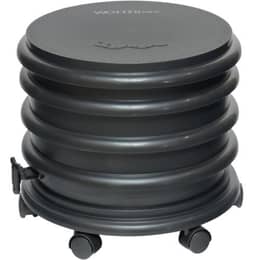
WORMbox Wormery | 2 trays
From 2 to 4 trays with optional planter, 13 litres of usable capacity per tray
£47.96 €57.50
Fast and odourless, compost worms eat your waste and turn it into worm casting for your plants.

From 2 to 4 trays, with an optional planter.

Up to 18 growing areas around a central wormery.

Terracotta with flower pot.

2 to 4 trays with a lower shelf.

Trays you add over time, for easy harvesting of vermicompost.

Turn your planters and flower beds into a wormery: WORMacotta, In-Ground.
 Practical guide

From the kitchen to the garden, your compost becomes simple, quick, and effective for everyone.
 Practical guide
 Practical guide
Live animals (worms and bait) and products to feed and care for pets and livestock.

Eisenia compost worms for your wormery or composter.

Ultra-fresh worms: compost worms, Dendros and Canadians from 100 g to 1 kg.

Natural solutions dedicated to the wellbeing of horses, ponies and donkeys.

Optimise the health and performance of your farm.

Mealworms, natural and nutritious supplements.
Enhance your home with our decorative items and care for your house in a natural and sustainable way.
Garden in an eco-friendly way that respects nature, for healthy and sustainable plants.
EM-based products designed to enrich soils, protect plants, support animal health, and make everyday well-being and maintenance easier.

Contains a blend of 80 families of beneficial microorganisms.

Revitalise, purify and improve water quality in all your applications.

Stimulate soil microbial activity and plant growth.

Cleanse and maintain your environment naturally.

For the wellbeing and health of pets, livestock and horses.

Enrich your body care or dietary routines with essential enzymes.
 Practical guidePractical guide

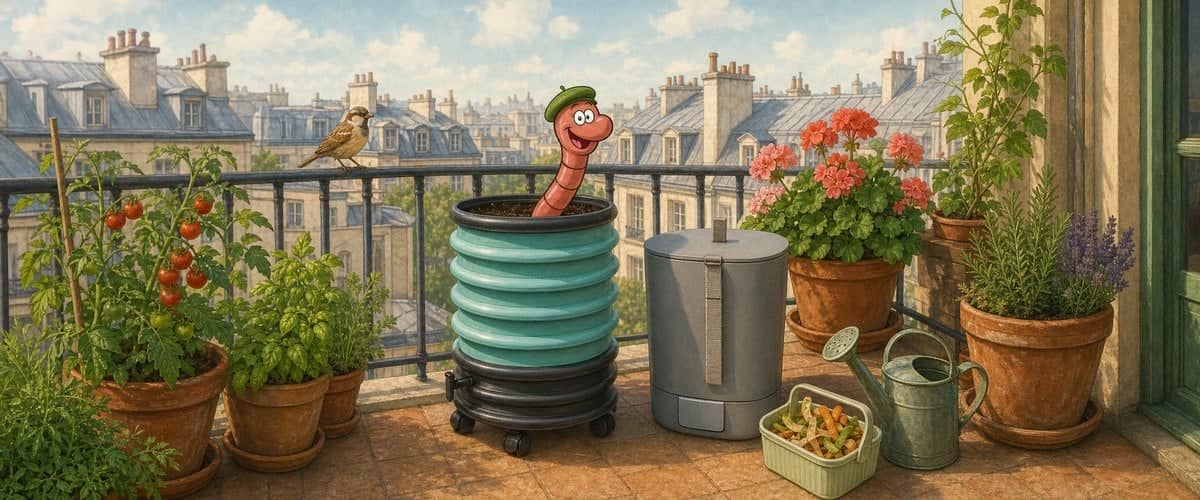
No garden, no compost? That is the misconception that puts off more city dwellers than any other. Yet living in a flat doesn't stop you making good use of your peelings: there are several options, some to set up at home, others just a few steps from your door. None of them suits everyone, and that is exactly what this guide is about.
Here are their strengths and constraints, to help you choose. For the details of each method, please see our dedicated guides.
Yes, and it's well worth doing: organic waste makes up around a third of our bins. In the EU, separate collection of organic waste has been mandatory since the end of 2023, and in the UK and Ireland more and more councils offer a food waste collection, whether or not you have a garden. Check with your council or waste service to find out what applies where you live. We cover this framework in our guide to mandatory organic waste sorting.
The options fall into two groups:
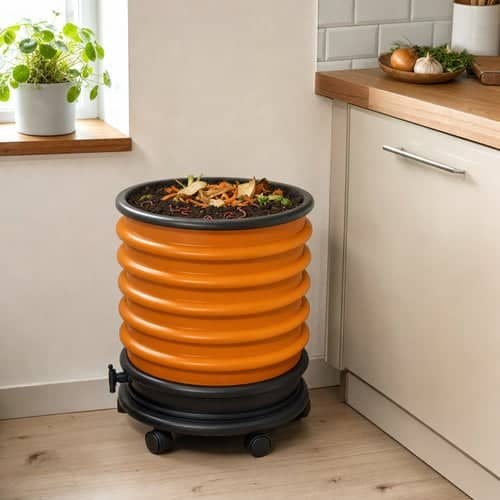 This is the option to favour when you don't have a garden. Compost worms (Eisenia) digest your peelings in a compact bin, at room temperature, without heating up. A wormery can be set up indoors or outdoors, in the shade and protected from frost, and you should allow around four months before getting compost that is ready to use.
Its strengths: it works all year round, doesn't smell if it is well balanced, and produces vermicompost and worm tea, both much appreciated by plants. Its limitation: it doesn't take everything. Meat, fish, dairy products or large amounts of citrus fruit don't belong in it, and like anything living, it needs a little attention.
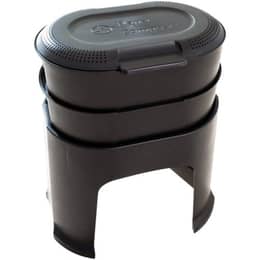
We have devoted a whole guide to the subject. For choosing a spot, start with our guide Wormery in a flat: how to set it up properly, then follow our method to start your wormery step by step. A stacking-tray model such as the WORMbox wormery fits easily into a kitchen.
Willy's tipBefore buying, check with your local council: some offer wormeries to residents, sometimes free or at a reduced price, occasionally with a short training session.
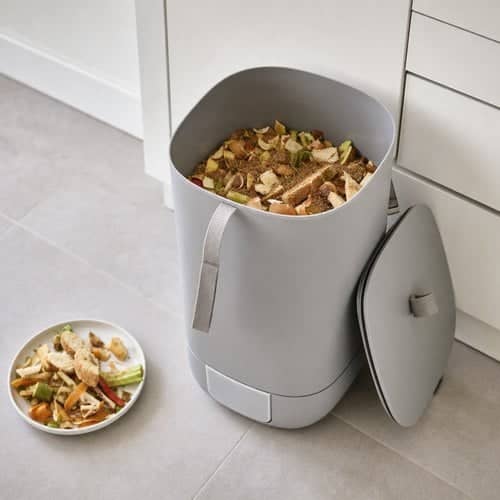 Bokashi works on a completely different principle. Your meal leftovers are pressed down in an airtight bucket and sprinkled with an activator, a fermented bran rich in micro-organisms. Without air, they don't rot: they ferment, rather like sauerkraut. After two to three weeks in the closed bucket, you get an acidic, stabilised material.
Its big advantage: it accepts almost all food leftovers, including meat, fish and dairy products in small pieces, which the wormery won't take. It takes up little space and stays discreet with the lid closed.
But let's be clear: bokashi is not finished compost. The fermented material still has to break down, whether buried in soil, added to a composter, given in small amounts to worms, or mixed with soil in a large container. In a flat, this second stage is what you need to sort out before getting started. Another constraint: you need a supply of activator, bought or homemade. Everything is explained in our guide to bokashi, and our Bokashi EM compost activator is ready to use.
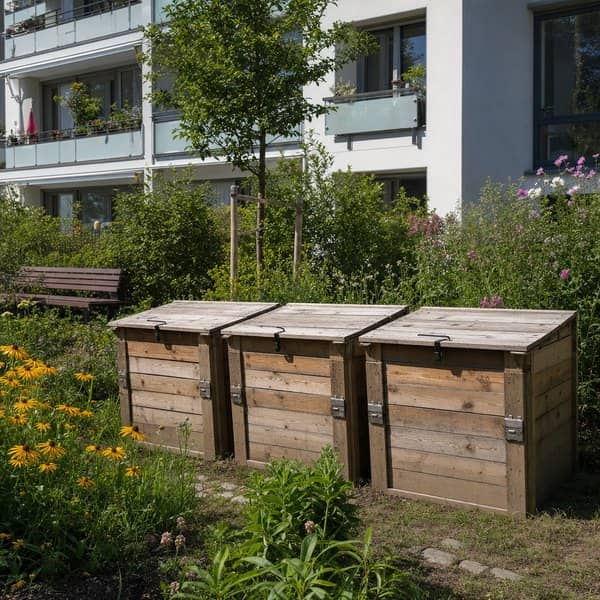
If you don't want to set anything up at home, shared composting is an excellent option. It comes in two main forms: the composter at the foot of a block of flats, reserved for residents, and the neighbourhood composter, often run by a community group in a community garden or public space, open at set times.
The principle is simple: you keep your peelings in a small kitchen caddy, then drop them into the communal bin, covering them with dry material. In return, you get a share of the compost. Each site has its own rules, often stricter than at home. And if there's no composter near you, there's nothing to stop you starting one with your neighbours: our guide Shared composter: a how-to guide sets out the steps.
This is the simplest option day to day. Depending on where you live, collection is either kerbside, in a dedicated bin, or at a drop-off point, meaning a specific container set up in the street. Your food waste is then processed in industrial facilities, by composting or anaerobic digestion.
You don't get any compost back, but your leftovers no longer end up with general household waste. The only useful equipment: a kitchen caddy, ideally ventilated or fitted with a lid, such as the Urbalive 6L compost bin. To find out whether there's a collection where you live and what it accepts, contact your council or waste service.
More and more kitchen appliances are being sold as “electric composters”. The name is misleading. In a few hours, these machines heat, stir and grind food leftovers: they dehydrate them, which greatly reduces their volume and limits odours. But there is no composting, meaning no slow transformation by the living organisms of the soil.
What comes out is a dry material, stabilised but still immature. To feed the soil, it must in turn break down: be mixed with soil, added to a composter or wormery, and it's advisable to wait before sowing or planting in it. You also need to factor in the purchase price (several hundred euros), electricity consumption of around one kilowatt-hour per cycle according to manufacturers, and filters to replace.
Our view: it's a convenience appliance, which can be useful if you have no access to any other option and know someone who can make use of the resulting material. It is not a shortcut to compost.
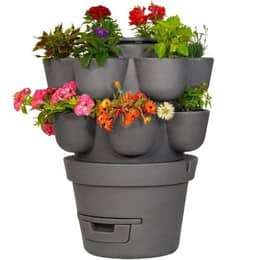
A balcony or terrace widens your options. A wormery can go there, sheltered from rain and full summer sun. There are also wormeries combined with a planter, which feed your plants directly: we introduce them in our guide Wormery with planter.
A compact tumbler composter can sit on a large terrace, but let's be realistic: it produces fresh compost that still needs to mature for three to five months in a heap before use, and it becomes heavy once full. For flat dwellers, it mainly suits those with a courtyard or a patch of ground.
To point you in the right direction, ask yourself these few questions:
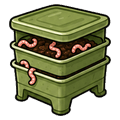 Do you have plants, a balcony, and the urge to make your own fertiliser? The wormery is for you.
 Do you want to make use of all your leftovers, meat included, and do you have an outlet (a friend or relative's garden, a large container of soil, a composter that accepts it)? Bokashi.
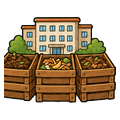 Short on time or space, but there's a shared composter near you? Join it.
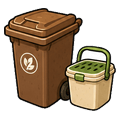 None of that possible? Your council's collection is still a real solution.
These options combine very well: many city dwellers have a wormery for their peelings and use the collection for the leftovers the worms won't take.
Key pointsIn a flat, the wormery and bokashi are done at home; the shared composter and the collection happen outside. The electric composter, for its part, dries waste but doesn't produce compost.
Living without a garden doesn't stop you composting. The wormery remains the go-to option for turning your peelings into compost at home, bokashi lets you ferment everything provided you plan the next step, and both shared composters and council collection offer simple alternatives without setting anything up. Finally, the electric composter is a convenience appliance rather than a true composter. Choose according to your space, your plants and your time, and don't hesitate to combine several options.
Scan the code or visit mouttafarm.co.uk/guide: all our practical guides, with links to the products mentioned.



 France
 Belgium
 Switzerland
 Germany
 Austria
 Italy
 Spain
 Holland
 Portugal
 Ireland
 Sweden
 Finland
 Denmark
 Greece
 Poland
 Rumania
 Czech Republic
 USA
