











Best Seller
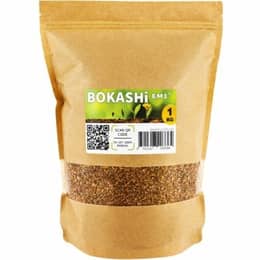
Bokashi EM compost activator | 1 kg bag
Individually or in sets of 2 or 3 bags
£5.99 €7.18
Fast and odourless, compost worms eat your waste and turn it into worm casting for your plants.

From 2 to 4 trays, with an optional planter.

Up to 18 growing areas around a central wormery.

Terracotta with flower pot.

2 to 4 trays with a lower shelf.

Trays you add over time, for easy harvesting of vermicompost.

Turn your planters and flower beds into a wormery: WORMacotta, In-Ground.
 Practical guide

From the kitchen to the garden, your compost becomes simple, quick, and effective for everyone.
 Practical guide
 Practical guide
Live animals (worms and bait) and products to feed and care for pets and livestock.

Eisenia compost worms for your wormery or composter.

Ultra-fresh worms: compost worms, Dendros and Canadians from 100 g to 1 kg.

Natural solutions dedicated to the wellbeing of horses, ponies and donkeys.

Optimise the health and performance of your farm.

Mealworms, natural and nutritious supplements.
Enhance your home with our decorative items and care for your house in a natural and sustainable way.
Garden in an eco-friendly way that respects nature, for healthy and sustainable plants.
EM-based products designed to enrich soils, protect plants, support animal health, and make everyday well-being and maintenance easier.

Contains a blend of 80 families of beneficial microorganisms.

Revitalise, purify and improve water quality in all your applications.

Stimulate soil microbial activity and plant growth.

Cleanse and maintain your environment naturally.

For the wellbeing and health of pets, livestock and horses.

Enrich your body care or dietary routines with essential enzymes.
 Practical guidePractical guide

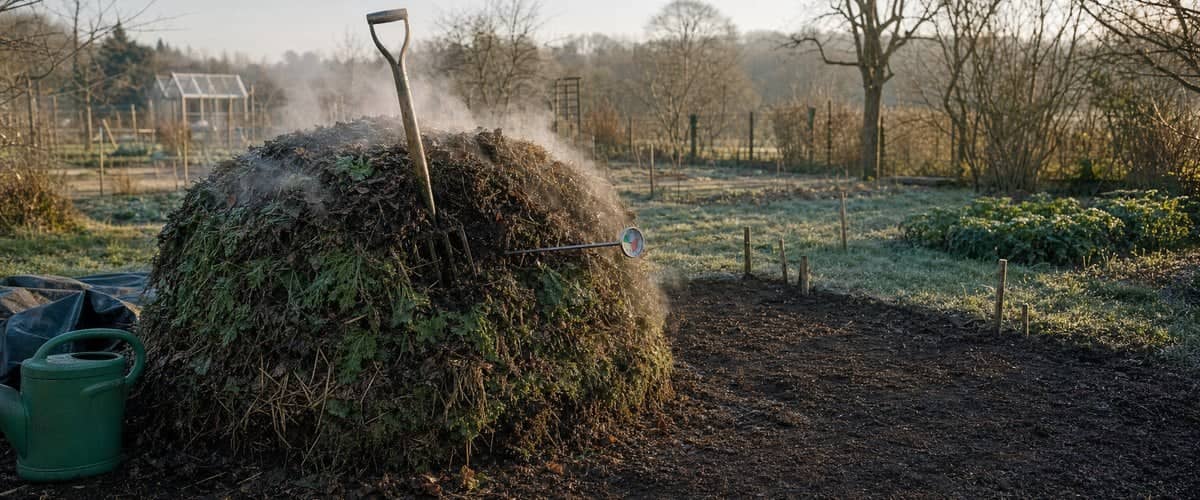
Compost in 18 days, when it usually takes four to nine months in a bin: the promise of the “Berkeley method” is certainly appealing. It is widely shared on gardening and permaculture blogs, often presented as a miracle recipe.
It does indeed work, provided you follow some fairly demanding rules. Here is what hot composting involves, how to go about it, what it really offers, and why it is not suitable for every garden.
In most gardens, compost is made “cold”: waste is added day by day, and decomposition progresses slowly. Home composting usually happens without any noticeable rise in temperature. There is nothing wrong with that: the compost still forms, just more slowly.
Hot composting, on the other hand, aims to trigger and maintain the hot phase of composting, which we describe in our guide How is compost made? Above about 40 °C, heat-loving micro-organisms take over. From 55 °C, many germs that cause disease in humans or plants are destroyed. But above about 65 °C, the heat also kills useful micro-organisms and decomposition slows down. The whole art of hot composting lies in staying within this range.
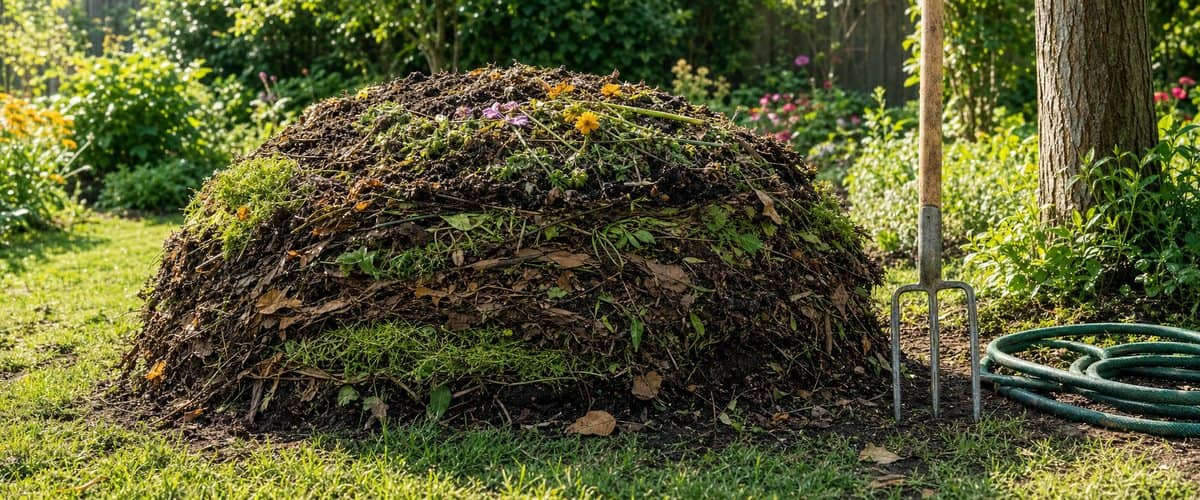
The Berkeley method relies on four conditions.
The heap should measure at least 1 m by 1 m at the base and around 1.5 m high. Any smaller and it loses too much heat. Above all, it is built in one go: nothing is added afterwards. So you need to have gathered all the material in advance.
The method aims for a carbon-to-nitrogen ratio of 25 to 30 to 1, by weight. In practice, this roughly corresponds to one volume of green materials (grass clippings, peelings, manure) to two volumes of brown materials (leaves, straw, shredded wood). We explain these ideas in our guide Green and brown materials.
Branches and woody materials need to be shredded. There is no need, however, to reduce everything to crumbs: roughly cut pieces are enough.
Each layer is watered as the heap is built. A good guide: a handful squeezed in a gloved hand should release only about one drop.
Some gardeners place a “starter” at the heart of the heap: a few plants such as nettle or comfrey, a little manure or a shovelful of old compost. As we will see in our guide Compost activators, this boost is optional.
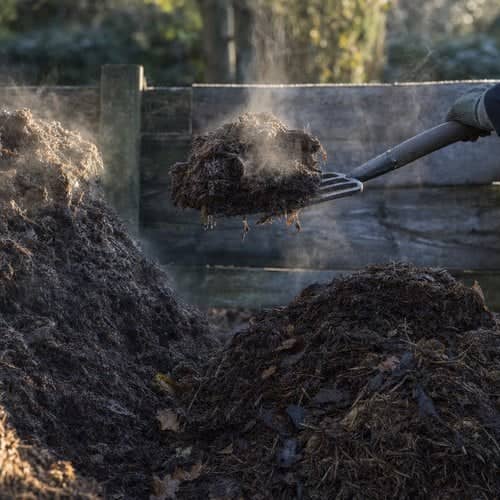 Here is the typical sequence:
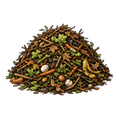 Day 1: build the heap in alternating layers, watering each one.
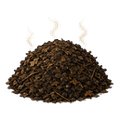 Days 2 to 4: leave it to rest. The heap heats up.
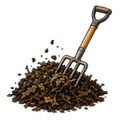 Day 5: first turn. Material from the outside goes to the centre, and vice versa.
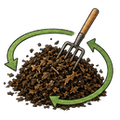 Days 7, 9, 11, 13, 15 and 17: turn the heap every other day, checking the temperature.
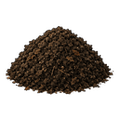 Day 18: the heap has cooled down; it is dark and crumbly.
The heat usually peaks between the 6th and 8th day. Turning a one-cubic-metre heap with a fork, seven times in two weeks, is real physical work. The easiest approach is to have two spaces side by side, for example two bays of a wooden composting system such as the Compostys wooden composter, and to move the heap from one to the other.
Did you know?At the end of the 18 days, most of the work is done, but all compost then goes through a cooling and maturing phase lasting several months. Before using it for sowing, check its maturity with the cress test.
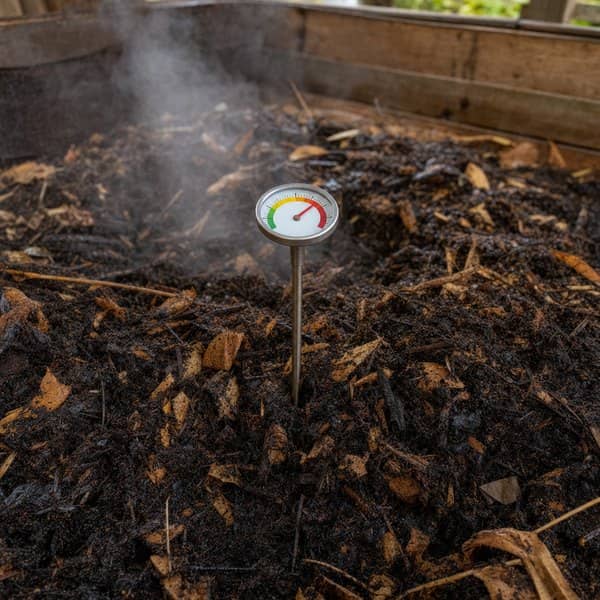
The ideal tool is a compost thermometer with a long probe that reaches the heart of the heap. The target is between 55 and 65 °C. By way of comparison, a well-managed heap can reach 54 to 71 °C.
Without a thermometer, your hand gives a first indication: if the inside of the heap feels uncomfortably hot to the touch, the temperature has probably been reached. A few signs to look out for:
 The heap stays lukewarm: it probably lacks nitrogen, water or volume. Turn it, adding green materials.
 The heap gets too hot, smells strong and sinks quickly: too much nitrogen. Add a little sawdust or shredded wood when turning it.
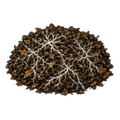 A white felt-like layer appears: this is a sign that the temperature is too high; it disappears as the heap cools.
 The heap no longer heats up after turning: it has reached a stable state.
Hot composting has one major benefit: the heat destroys a good proportion of weed seeds and germs. A well-built heap reaches about 54 °C within a week, which is enough to kill many seeds. The most resistant ones, however, require 30 days at 63 °C or more.
Let's be honest: even when well managed, 18-day hot composting therefore offers no absolute guarantee. The edges of the heap stay cooler, hence the importance of turning it thoroughly. To be on the safe side, we still advise you to leave out weeds that have gone to seed and diseased plants, as we explain in our guide on debatable waste.
The Berkeley method is fascinating, but it is not for everyone:
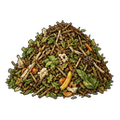 You need a lot of material at once: one cubic metre is far more than a kitchen produces in several months. It is best suited to autumn or spring, when the garden provides plenty of grass clippings, leaves and prunings.
 It takes time and energy: a complete turn every two days.
 It uses water, especially in summer.
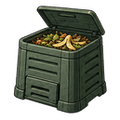 It does not replace your everyday composter, where you add your peelings as you go.
For most families, “cold” compost, mixed regularly with an aerator such as the Brass'Compost, remains the simplest solution. Hot composting can be a useful addition, once or twice a year, to process a large volume of garden waste.
Key pointsBerkeley method: at least 1 m³ built in one go, one volume of green to two of brown, the moisture of a wrung-out sponge, and a turn every two days from day 5. The compost obtained on day 18 still needs to mature before sowing.
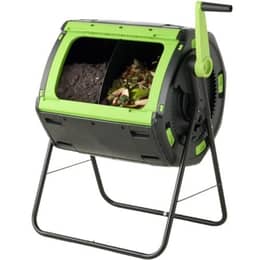
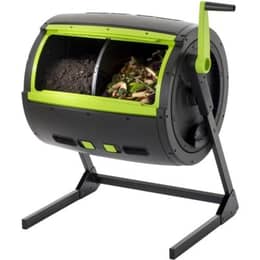
The tumbler composter is sometimes presented as an easy way to hot compost. It can indeed heat up, especially in summer, if it is filled in one go. But in cold weather it struggles to get hot, and what comes out is still fresh compost that needs to mature for several more months. We present its real strengths, and the timescales to expect, in our guide Tumbler composter.
Hot composting using the Berkeley method produces well-decomposed material in 18 days, provided you gather at least one cubic metre of waste at once, take care with the mix and moisture, and turn the heap every other day while monitoring the temperature. It destroys a good proportion of weed seeds, without any absolute guarantee, and the end product benefits from further maturing before sowing. It is a worthwhile technique for processing a large volume of garden waste, but for most households, well-maintained “cold” compost remains the simplest solution.
Scan the code or visit mouttafarm.co.uk/guide: all our practical guides, with links to the products mentioned.



 France
 Belgium
 Switzerland
 Germany
 Austria
 Italy
 Spain
 Holland
 Portugal
 Ireland
 Sweden
 Finland
 Denmark
 Greece
 Poland
 Rumania
 Czech Republic
 USA
