











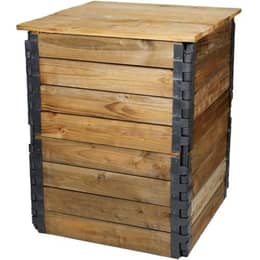
Compostys wooden composter | 305 litres
PEFC-certified spruce wood
£96.62 €115.83
Fast and odourless, compost worms eat your waste and turn it into worm casting for your plants.

From 2 to 4 trays, with an optional planter.

Up to 18 growing areas around a central wormery.

Terracotta with flower pot.

2 to 4 trays with a lower shelf.

Trays you add over time, for easy harvesting of vermicompost.

Turn your planters and flower beds into a wormery: WORMacotta, In-Ground.
 Practical guide

From the kitchen to the garden, your compost becomes simple, quick, and effective for everyone.
 Practical guide
 Practical guide
Live animals (worms and bait) and products to feed and care for pets and livestock.

Eisenia compost worms for your wormery or composter.

Ultra-fresh worms: compost worms, Dendros and Canadians from 100 g to 1 kg.

Natural solutions dedicated to the wellbeing of horses, ponies and donkeys.

Optimise the health and performance of your farm.

Mealworms, natural and nutritious supplements.
Enhance your home with our decorative items and care for your house in a natural and sustainable way.
Garden in an eco-friendly way that respects nature, for healthy and sustainable plants.
EM-based products designed to enrich soils, protect plants, support animal health, and make everyday well-being and maintenance easier.

Contains a blend of 80 families of beneficial microorganisms.

Revitalise, purify and improve water quality in all your applications.

Stimulate soil microbial activity and plant growth.

Cleanse and maintain your environment naturally.

For the wellbeing and health of pets, livestock and horses.

Enrich your body care or dietary routines with essential enzymes.
 Practical guidePractical guide

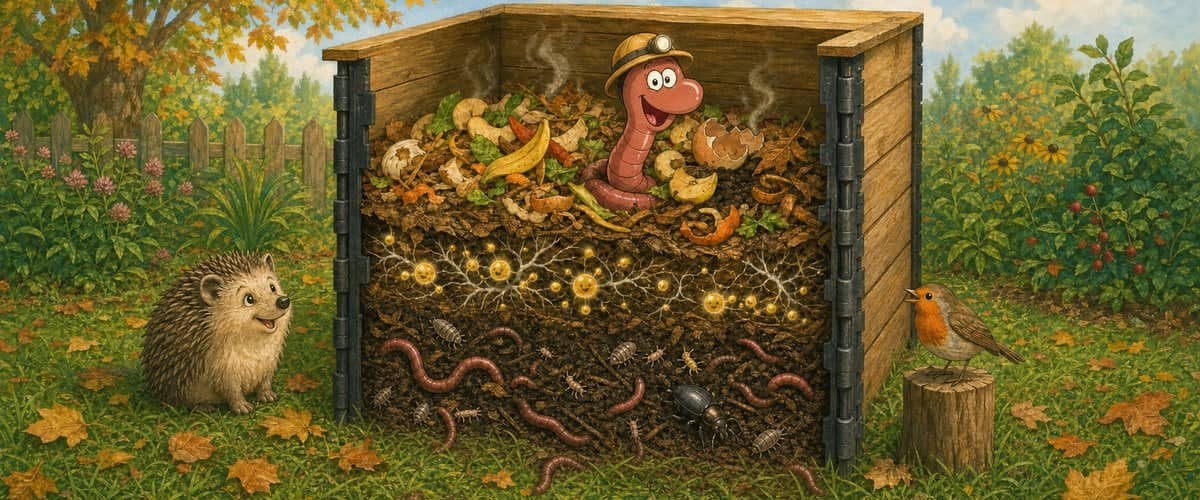
A carrot peeling that, a few months later, becomes a brown, crumbly soil smelling of the forest floor: there is something magical about compost. Yet there is no secret to it, just a host of living creatures that eat, breathe and take turns inside your composter.
Understanding what goes on inside is the best way to make good compost without asking yourself a hundred questions. Here are the main stages of the transformation, explained simply, along with the few rules that follow from them.
 Composting means letting living organisms break down organic matter in the presence of oxygen. Kitchen and garden waste is their food: they draw carbon from it for energy and nitrogen to build their own cells, and they need water and air to live. What they leave behind, after many successive meals, is compost: a stable material, rich in humus, which is then returned to the soil.
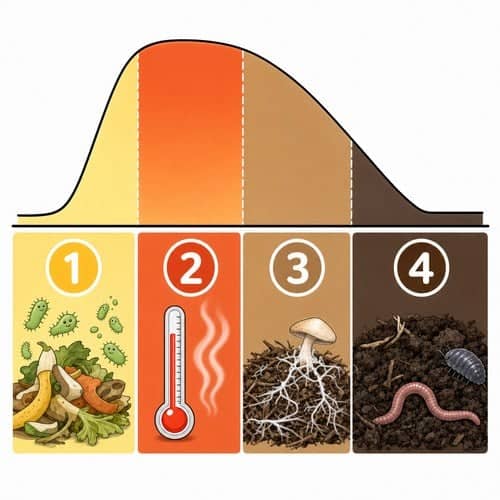
The key words are “in the open air”. When oxygen runs short, because the heap is too compacted or waterlogged, the organisms that need air suffocate. Other micro-organisms then take over. They work without oxygen, as in a landfill or at the bottom of a pond, and produce methane, a powerful greenhouse gas, as well as foul-smelling gases. That is why compost that smells bad is usually short of air. The diagram summarises the four phases described in detail below: warming up (1), the hot phase (2), cooling (3) and maturation (4).
A single gram of compost is home to billions of micro-organisms. Bacteria make up 80 to 90% of them. They carry out most of the decomposition and produce the heat you can sometimes feel when you plunge your hand into an active heap.
Fungi (moulds and yeasts) tackle the tough debris that bacteria struggle to digest: dry stems, thick leaves, cardboard. Actinomycetes, bacteria that form fine filaments, break down cellulose and some of the wood. Their whitish, web-like network can often be seen in the outer layer of the heap towards the end of composting: this is not a disease, it is a sign that the work is progressing.
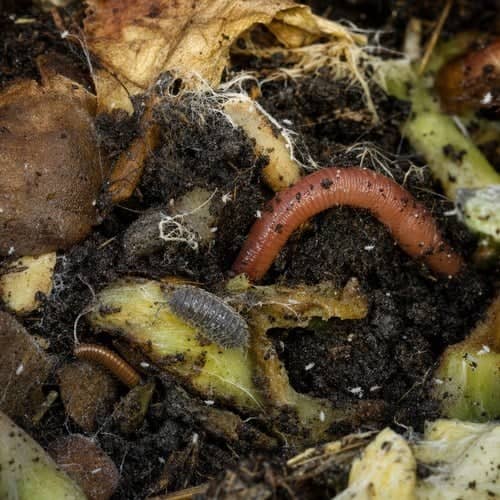
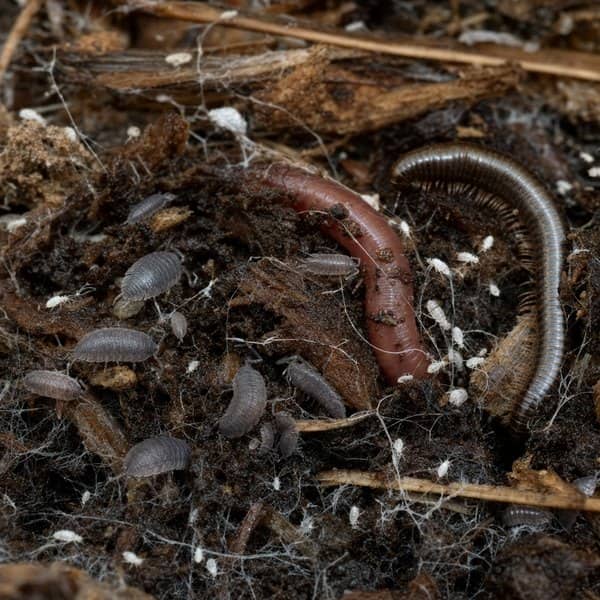
Once the material has cooled, larger animals move in: earthworms, woodlice, millipedes, mites and small beetles. They break the waste into pieces, mix it and open the way for micro-organisms. Earthworms play a leading role here, which we describe in detail in our guide The role of earthworms.
Did you know?These micro-organisms do not come from a sachet: they are already present on your peelings, on dead leaves and in your garden soil. A well-balanced compost populates itself. A helping hand is still useful in some cases: sprinkled over kitchen scraps, our bokashi activator, made on the farm, helps to limit bad smells and to kick-start compost that is slow to get going. We explain when to use it in our guide Compost activators: useful or not?
Just after a large addition of fresh waste, so-called mesophilic micro-organisms, which like moderate temperatures, get to work. They first consume whatever breaks down most easily: sugars, starches and soft materials. This intense activity gives off heat. In a well-stocked heap, this first phase lasts only a few days.
When the temperature rises above about 40 °C, heat-loving species, known as thermophiles, take over. They carry on breaking down the more resistant materials. This phase can last from a few days to several months, depending on the volume and the mix.
Two thresholds are worth knowing. From 55 °C, a good proportion of germs that are harmful to humans and of plant diseases are destroyed. Above about 65 °C, however, the heat also kills many of the useful micro-organisms and decomposition slows down: hotter compost is therefore not necessarily better compost.
 Once the easily digested materials have been used up, activity drops and the temperature gradually falls. Mesophilic organisms return, fungi and actinomycetes tackle the toughest remains, and then small creatures colonise the whole lot. This is the cooling phase, followed by maturation, during which humus forms.
Some books speak of three phases, grouping cooling and maturation together; others count four. The way it is divided up does not matter: just remember that this final stage is the longest. It lasts several months, and it is what makes the difference between “fresh” compost, still active, and mature compost, dark and crumbly, ready for the vegetable patch. We explain how to tell them apart in our guide How to tell if your compost is mature.
Temperatures of 55 to 65 °C are mainly reached in the large heaps on industrial sites, which commonly exceed 60 °C. In a household composter, the volume is small and heat easily escapes through the sides and top. Let us be clear: the temperature there generally stays low, and it is not enough to guarantee that germs and weed seeds are destroyed.
This is not a failure. “Cold” compost works very well: it is simply slower, and small creatures play a bigger role in it. There is just one practical consequence to draw from this: since your composter does not sanitise, avoid putting diseased plants and weeds that have gone to seed in it. If you would like to try your hand at very hot composting, our guide on hot composting and the Berkeley method sets out its rather demanding conditions.
Key pointsCompost is made in four stages: a rapid start, a hot phase, cooling, then a long maturation. In a garden composter, the hot phase is low-key: this is normal, but it explains why some waste must still be left out.
Without oxygen, the good workers stop and the smells arrive. A light stir with each addition, then a more thorough mix about once a month, with a fork or an aerator such as the Brass'Compost, is generally enough. The right rhythm for your equipment is explained in our guide on compost moisture and aeration.
Micro-organisms live in thin films of water. Too dry, and everything stops; too wet, and air can no longer get through. A good benchmark: compost as damp as a sponge that has just been wrung out.
Nitrogen-rich waste (peelings, grass cuttings) breaks down quickly but rots on its own; carbon-rich waste (dry leaves, twigs, cardboard) is slow but provides structure. It is mixing them that properly feeds the micro-organisms, as we explain in our guide Green and brown materials.
Garden compost takes several months: allow four to nine months in a bin depending on the season and maintenance, and six to twelve months in a heap. A bin such as our Compostys wooden composter, placed directly on the soil, lets small creatures come up from the ground and finish the job at their own pace.
Compost is the work of a chain of living organisms: bacteria that get things started and heat up the heap, fungi and actinomycetes that tackle the tough materials, then worms and small animals that complete the transformation during a long maturation. In a household composter, the heat stays moderate: compost still forms, but it does not sanitise everything. For these workers to do their job well, they need air, a reasonable amount of water, a mix of green and brown waste, and a few months of patience.
Scan the code or visit mouttafarm.co.uk/guide: all our practical guides, with links to the products mentioned.



 France
 Belgium
 Switzerland
 Germany
 Austria
 Italy
 Spain
 Holland
 Portugal
 Ireland
 Sweden
 Finland
 Denmark
 Greece
 Poland
 Rumania
 Czech Republic
 USA
